
Generative Engine Optimization: How to Get Cited by AI
Generative engine optimization explained: how AI assistants pick sources, how to rank in AI Overviews and which GEO tools measure AI visibility. Read on.
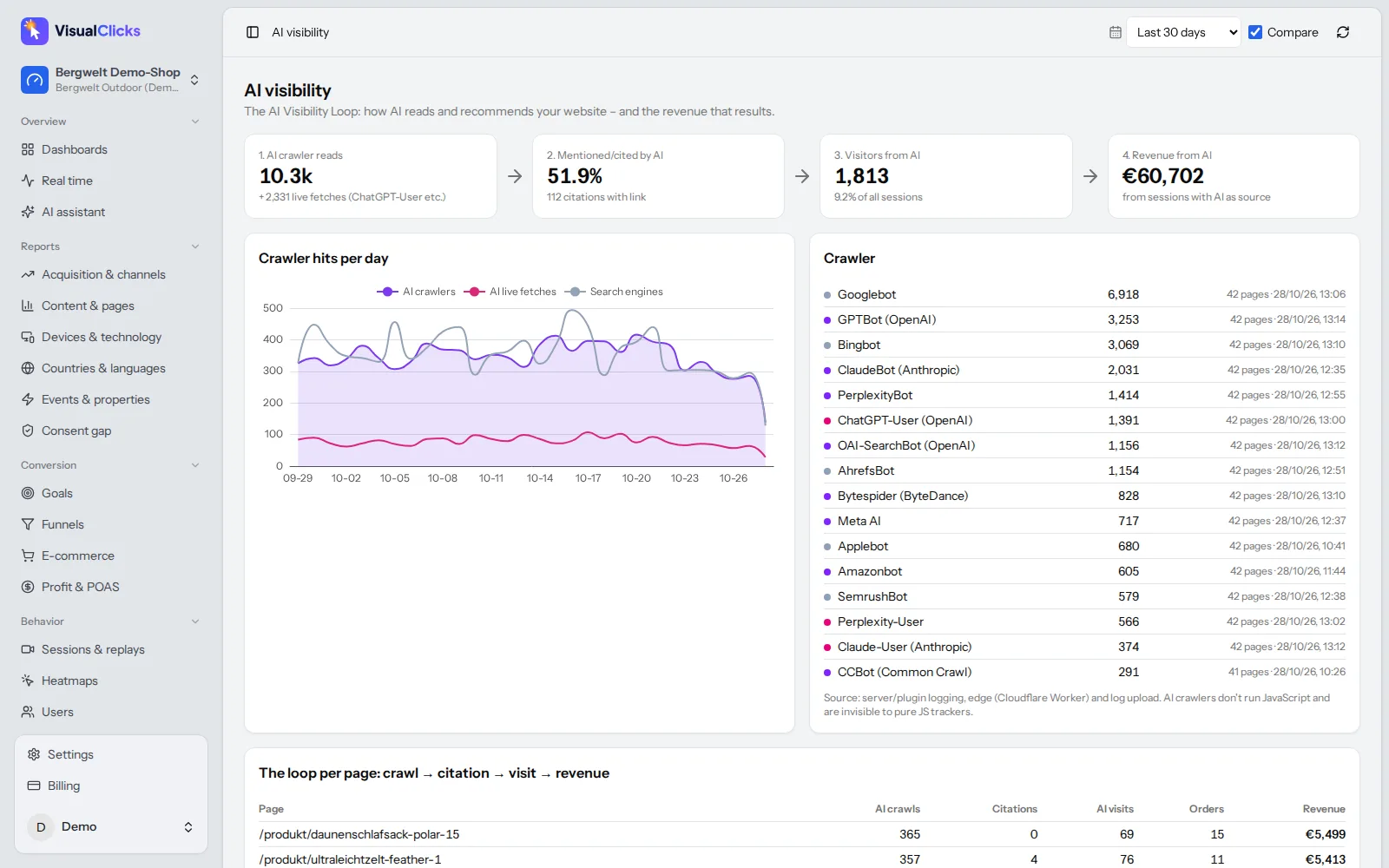
More and more people ask ChatGPT, Perplexity, Gemini, Copilot or Claude instead of typing keywords into a search box. These assistants reply with a finished answer and cite only a handful of sources. Generative engine optimization (GEO) is the practice of getting your content into those answers – cited, linked and recommended. This guide explains how AI assistants pick their sources, what actually moves the needle (including how to rank in AI Overviews), what llms.txt can and cannot do, and which generative engine optimization tools you need to measure your AI visibility instead of guessing.
What is generative engine optimization?
Generative engine optimization is the practice of optimizing content and site technology for generative search systems: AI assistants and AI search features that synthesize answers from multiple sources. The goal shifts from "rank in a list of ten links" to "be the source the AI quotes, the brand it names, the product it recommends".
The term comes from research. A team led by Pranjal Aggarwal introduced it in the 2023 paper "GEO: Generative Engine Optimization", later published at KDD 2024. The authors tested which content changes increase visibility in generated answers and found that results vary considerably by domain. In other words: even the people who coined the term don't claim there is one universal recipe.
Google, for its part, does not treat GEO as a separate discipline. Its guide to optimizing for generative AI search states that optimizing for generative AI search is optimizing for the search experience – and therefore still SEO. You'll also see the labels AEO (answer engine optimization) and LLMO. They describe the same goal from slightly different angles.
GEO vs. SEO at a glance
| Traditional SEO | Generative engine optimization | |
|---|---|---|
| Goal | Rank high in the results list | Get cited, mentioned or recommended |
| What the user sees | A list of links | A synthesized answer with a few sources |
| Unit of competition | The whole page | Often a paragraph, a fact, a definition |
| Main metrics | Rankings, clicks, CTR | AI referral traffic, crawler visits, mentions in answers |
| Typical tools | Search Console, rank tracker | Analytics with an AI channel, log analysis, prompt monitoring |
If your SEO fundamentals are solid, you've already done most of the work. What's usually missing is measurement.
How AI assistants choose their sources
To do GEO well, you need to know where an assistant gets its information. There are two routes.
Training data. Language models are trained on large amounts of web text. Training crawlers such as GPTBot (OpenAI) and ClaudeBot (Anthropic) collect that content. What appears often and consistently becomes part of what the model "knows". This knowledge isn't current, and it doesn't send links or visitors to you.
Live retrieval. For current or specific questions, assistants search the web in real time: they query an index, fetch matching pages, read them and write an answer with citations. This is called retrieval-augmented generation. For AI Overviews and AI Mode, Google also describes query fan-out: the system runs several related searches in parallel to cover different aspects of one question.
Each provider relies on a different index:
- Google AI Overviews, AI Mode and Gemini use Google's index.
- ChatGPT search relies, among other things, on OpenAI's own crawler OAI-SearchBot.
- Perplexity runs its own crawler, PerplexityBot.
- Claude uses Claude-SearchBot for search.
- Microsoft Copilot builds on Bing.
The practical rule that follows: if a search crawler isn't allowed to fetch a page, or the page isn't indexed, it cannot be cited in a live answer.
How to rank in AI Overviews and other AI answers: 7 levers
None of these levers is exotic. They make your content easier to understand and easier to quote – for people and for machines.
1. Make sure search crawlers can get in
Check your robots.txt. Many sites block "all AI bots" in one go and accidentally remove themselves from AI search as well. Search crawlers (OAI-SearchBot, PerplexityBot, Claude-SearchBot) and training crawlers (GPTBot, ClaudeBot) can be controlled separately. For Google's AI features, the requirements are simply those of Google Search: the page must be indexed and eligible to show with a snippet. Also make sure important text is in the delivered HTML, not only injected by JavaScript.
2. Lead with the answer
AI systems like to quote passages that answer a question directly and completely. Open sections with a clear statement ("X is …", "To calculate Y, …") and add detail afterwards. A two-sentence definition is far more quotable than a paragraph that gets to the point after 200 words.
3. Use structure that can be extracted
Descriptive subheadings, tables, numbered steps and short paragraphs help systems understand what each part covers. That doesn't mean chopping your text into tiny fragments – Google explicitly says this isn't necessary. Structure for human readers, and machines benefit too.
4. Publish facts nobody else has
Google calls it "non-commodity content": original data, first-hand experience and expert takes that go beyond common knowledge. An AI doesn't need your page to explain the basics. It needs a source for the specific number, the test method, the real-world comparison. Cite your sources and add dates and context to every figure.
5. Make your entities unambiguous
Language models think in entities: companies, products, people, places. Use the same name for your brand and products everywhere, explain clearly on your About page who you are and what you offer, and link your official profiles. Structured data such as Organization or Product isn't required for AI search, but it still helps with rich results and with unambiguous identification.
6. Earn mentions beyond your own site
Assistants recommend brands that show up in several credible places: trade articles, comparisons, directories, community discussions. Bought or fake mentions don't count – Google warns against them explicitly. Real PR, guest articles and customer stories do.
7. Keep content fresh
For many questions, assistants prefer recent sources. Update key pages regularly, show a visible "last updated" date and remove outdated claims.
llms.txt: a proposal, not a standard
GEO discussions often bring up llms.txt. Jeremy Howard published it as a proposal in September 2024: a Markdown file at the root of your site that gives language models a short description and a curated list of your most important pages.
Here's where it honestly stands:
- llms.txt is not an official standard. It's a community initiative.
- Google says in its guide that Google Search doesn't use such files and that you don't need them to appear in Search.
- Whether and how other AI providers use the file is hardly documented publicly.
Our take: if you can publish one with little effort – for documentation or software products, for example – it does no harm. Just don't expect a measurable visibility effect, and spend your time on the seven levers first.
How to measure AI visibility
GEO without measurement is guesswork. AI visibility can be measured on three levels that complement each other.
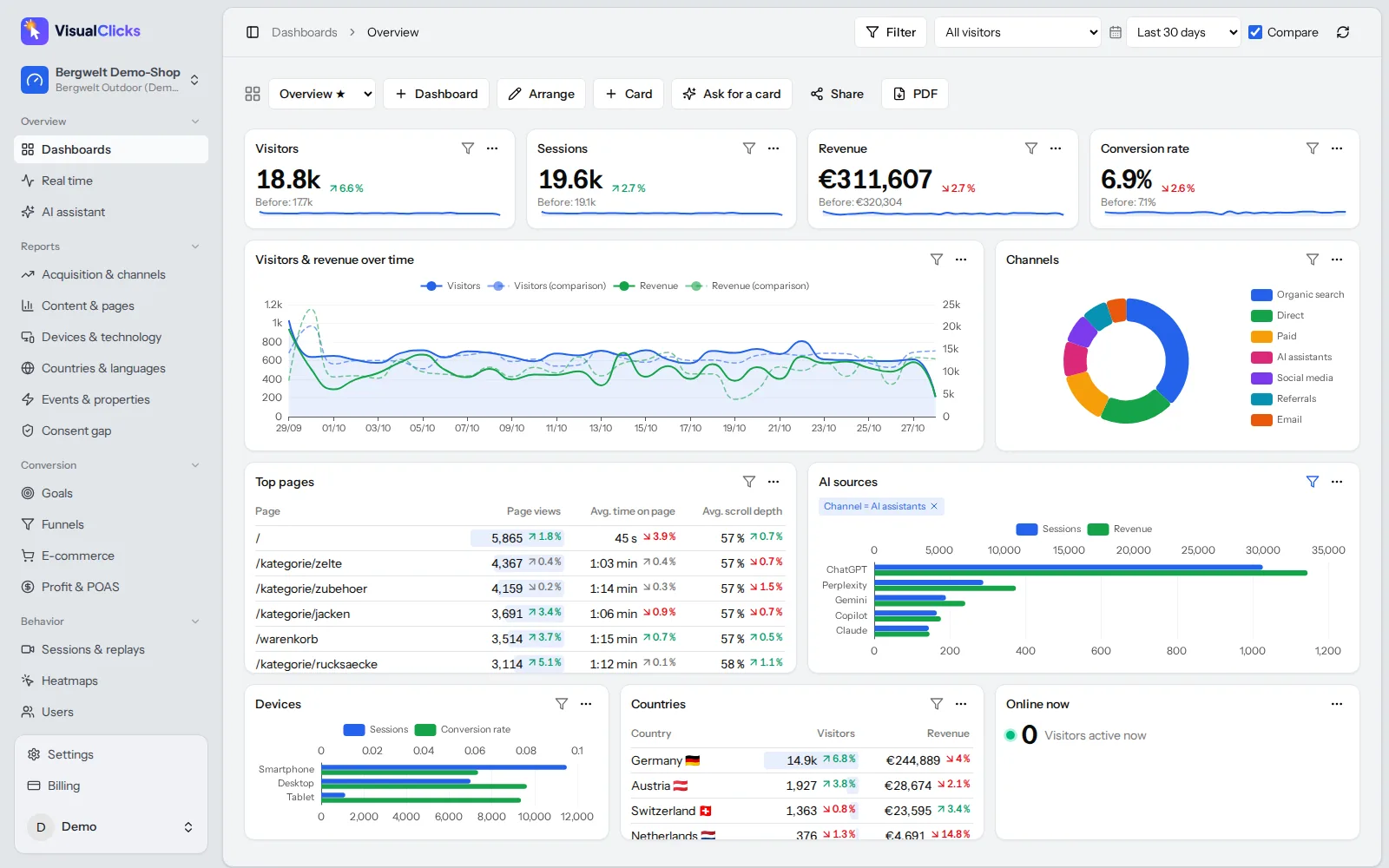
Level 1: Visitors from AI assistants (how to track ChatGPT traffic)
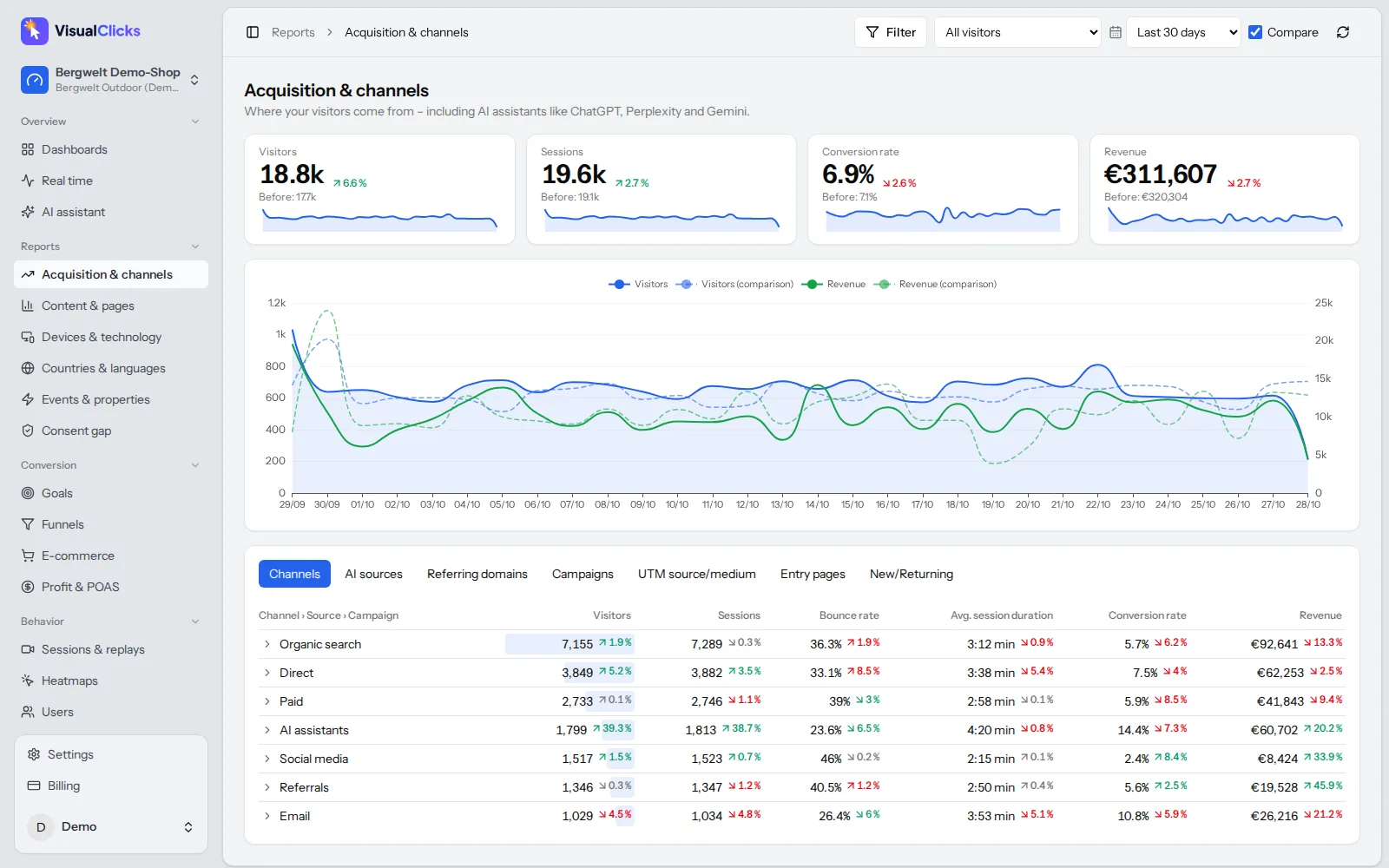
When someone clicks a source link in an AI answer, they land on your site – often with a recognizable referrer such as chatgpt.com, perplexity.ai, gemini.google.com, copilot.microsoft.com or claude.ai. According to OpenAI, ChatGPT also adds utm_source=chatgpt.com to the links it shows. To track ChatGPT traffic reliably, group these referrers and parameters into a dedicated "AI assistants" channel instead of letting them disappear into "Referral". If you're new to tagging, our guide to UTM parameters covers the basics.
One caveat: some clicks from mobile and desktop apps arrive without a referrer and end up in "Direct". Treat your measured AI traffic as a lower bound.
Metrics worth watching: visits per assistant, landing pages, engagement time and conversion rate. Visitors from AI answers have often done their research already and arrive with clear intent.
Level 2: Crawler visits
Your server logs show which AI crawlers fetch which pages. If OAI-SearchBot visits regularly, you can appear in ChatGPT search. If PerplexityBot never fetches a certain page, Perplexity is unlikely to cite it. Crawler data is an early indicator, long before visitors arrive.
Level 3: Prompt monitoring
The third level answers the real question: does the AI mention you?
- Define 20 to 50 questions your audience actually asks ("Which analytics tool works without a cookie banner?").
- Ask them regularly in the assistants that matter to you.
- Record whether your brand appears, in what position, with what statement, and whether your site is linked.
- Note which competitors are named instead.
AI answers vary from run to run, so the trend over several weeks matters more than any single answer.
On top of that, Google Search Console added generative AI performance reports in 2026. They show how often your URLs appeared in AI Overviews, AI Mode and generative AI features in Discover – impressions only, no clicks.
Generative engine optimization tools: what you actually need
The market for generative engine optimization tools is young and noisy. Google itself notes that no third-party tool has access to its internal ranking or AI systems, so be skeptical of anyone promising guaranteed placement. What you need is coverage of the three measurement levels plus a technical check:
| Tool category | What it answers | Examples of data |
|---|---|---|
| Web analytics with an AI channel | Do AI assistants send traffic and revenue? | Visits, landing pages, conversions per assistant |
| Crawler monitoring | Which AI bots read which pages? | Server logs, bot visits by user agent |
| Prompt monitoring | Is my brand mentioned in answers? | Mention rate, position, competitors |
| Technical audit | Can crawlers access my content? | robots.txt rules, sitemap, indexability |
| Google Search Console | Do I appear in Google's AI features? | AI feature impressions by page and country |
You can cover these with separate tools or with one platform. Either way, the key is that the data sits next to your normal analytics, so you can compare AI traffic with search, social and campaigns.
Common GEO mistakes
- Blocking every AI bot and then wondering why you never show up in AI search.
- Rewriting content "for the AI" until it reads worse for humans. Google says it isn't necessary.
- Relying on tricks: hidden instructions for language models, keyword lists, bought mentions. At best useless, at worst a spam policy violation.
- Tracking rankings only: a top ranking doesn't guarantee a mention in an AI answer, and vice versa.
- Letting AI traffic hide in "Referral" or "Direct" instead of analyzing it as its own channel.
- Treating llms.txt as a silver bullet: it doesn't replace good content.
How VisualClicks helps with AI visibility
VisualClicks brings all three measurement levels into one tool. In the analytics, AI assistants are a channel of their own: visits from ChatGPT, Perplexity, Gemini, Copilot and Claude are reported separately from search, social and referral. You see which pages these visitors land on, how long they stay and whether they convert. Funnels can be broken down by AI source as well.
The AI visibility section also shows which AI crawlers – GPTBot, ClaudeBot, PerplexityBot and others – visit your pages, and monitors defined prompts to see whether AI answers mention your brand. The SEO & domain check tests robots.txt, sitemap and llms.txt and flags whether you block AI crawlers – exactly the technical groundwork from lever 1.
Because VisualClicks web analytics measures cookieless by default, you capture AI visitors even if they never accept a cookie banner – a GDPR-friendly setup hosted in Germany.
Bottom line: GEO is SEO with a new measurement problem
Generative engine optimization doesn't require secret tricks. Let search crawlers in, answer questions directly and with evidence, publish original content instead of generic summaries, and earn genuine mentions. The real difference from traditional SEO is measurement: rankings alone won't tell you whether ChatGPT or Perplexity recommends you. Track AI visitors, crawler activity and mentions in answers, and you'll know which of your efforts actually work.
Frequently asked questions
What is generative engine optimization?
Generative engine optimization (GEO) is the practice of optimizing content and site technology so that AI assistants and AI search features – ChatGPT, Perplexity, Gemini, Google AI Overviews – cite your pages, mention your brand or recommend your product. The term was introduced in a 2023 research paper.
How do I rank in AI Overviews?
There is no separate ranking system to game. Google says pages need to be indexed and eligible to appear with a snippet, and that standard SEO practices apply. Answer questions directly, structure content clearly, publish original information and make sure Googlebot can crawl the page.
What are the best generative engine optimization tools?
Look for coverage of three measurement levels: web analytics with a dedicated AI assistant channel, crawler monitoring for bots like GPTBot or PerplexityBot, and prompt monitoring that checks whether AI answers mention your brand. Add a technical audit of robots.txt and Google Search Console for AI feature impressions.
How can I track ChatGPT traffic?
ChatGPT visits usually arrive with the referrer chatgpt.com, and OpenAI adds utm_source=chatgpt.com to links shown in ChatGPT. Group these into a dedicated AI channel in your analytics. Some app clicks arrive without a referrer and show up as direct traffic, so treat the number as a lower bound.
Do I need an llms.txt file?
No, it isn't required. llms.txt is a 2024 proposal, not an official standard, and Google says Google Search doesn't use such files. Publishing one costs little and does no harm, but don't expect a measurable visibility effect from it.
More articles
 Privacy
Google Analytics Alternative: 5 Tools Compared on the Facts
Why teams leave Google Analytics, what GDPR requires, how cookieless analytics works – and how GA4, Matomo, Plausible, Fathom and VisualClicks compare on verifiable facts.
Read more →
 Web analytics
What Are UTM Parameters? Meaning, Examples and How to Use Them
What UTM parameters mean, how to build and name UTM links step by step and how to read them in Google Analytics – with a builder template, AI traffic tips and common mistakes.
Read more →
 E-commerce
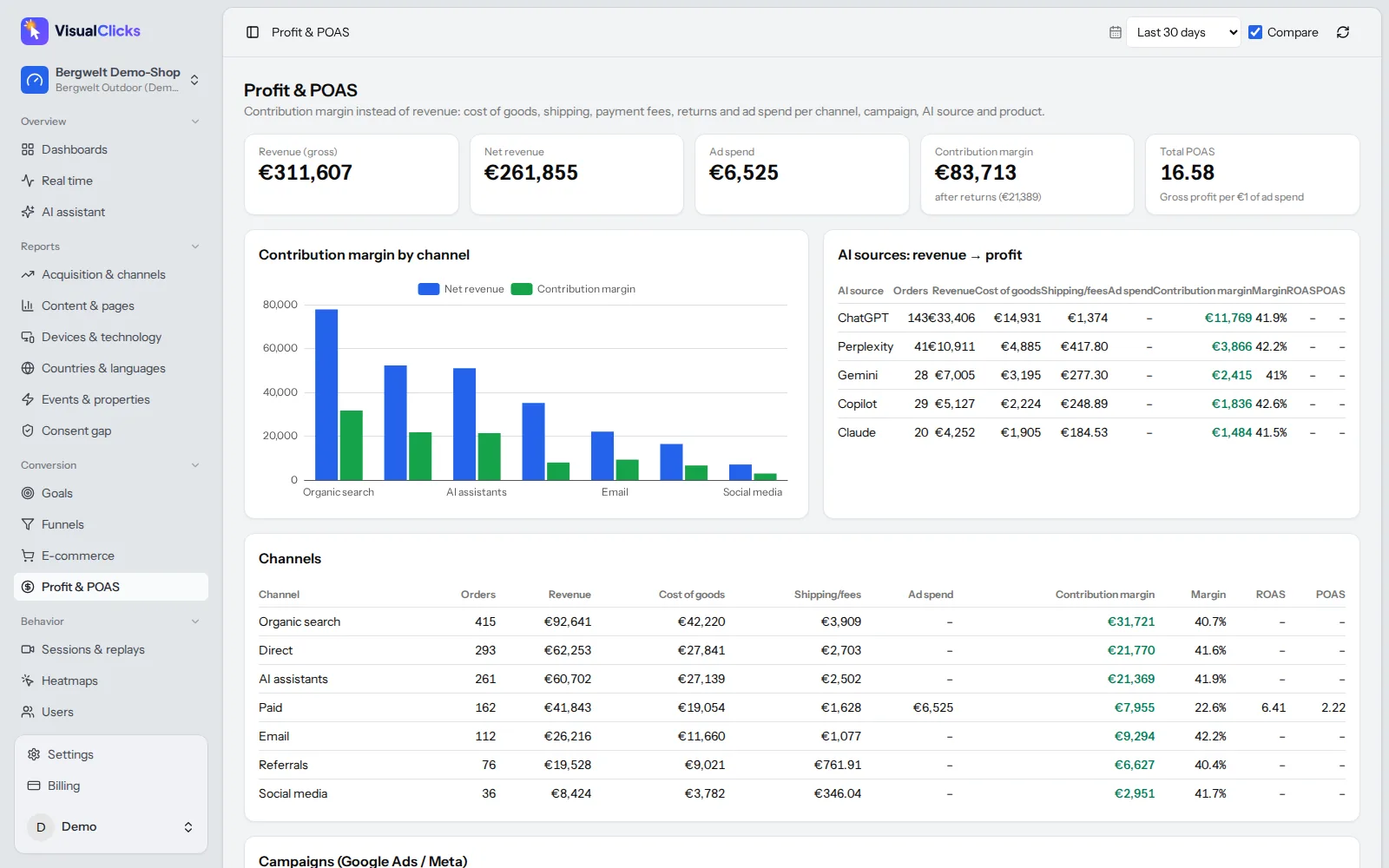
ROAS Calculation: Formula, Break-Even ROAS and POAS Explained
ROAS is quick to calculate but says nothing about profit. Break-even ROAS and POAS show which campaigns actually make money.
Read more →
See your website through new eyes
Request your access. After that, one line of tracking code is all it takes – the first visits show up in real time.